

How Life Insurance Covers Funeral Costs
When you die, the life insurance company will pay out a tax-free cash benefit to the beneficiaries, which they can use to cover funeral costs, cremation costs, debts, medical bills, and any other expense.
All types of life insurance pay out a tax-free cash benefit to whomever you named as the beneficiaries. They are legally entitled to spend that money on anything (there are no restrictions whatsoever).
Consider the type of policy if you’re relying on it to cover funeral costs
There are three main types of life insurance: whole life, term life, and universal life. If you plan to depend on a life insurance policy to cover your funeral expenses, then it’s critically important that you know how each one works.
Otherwise, you may one day find yourself without coverage, which means it won’t be there to cover your final expenses (the very problem you meant to solve).
Here’s a breakdown of how each type of policy works.
| Policy Features | Term Life Insurance | Whole Life Insurance | Universal Life Insurance |
|---|---|---|---|
| Payout money can be used for funeral costs | Yes | Yes | Yes |
| Length of coverage | Usually 10, 20 or 30 years | Forever | Forever |
| Typical age at which coverage ends | 80 | Never | Never |
| Fixed premiums | Often yes, but sometimes premiums increase over time | Yes | Yes & no |
| Affordability | Lowest cost | 2-20x more than term coverage | Always costs 2-5x more than term coverage |
| Guaranteed death benefit payout | Yes | Yes | Yes |
| Typical amount of minimum coverage you must buy | $50-$100K | $50-$100K | $50-$100K |
| Ideal reasons to buy | Temporary needs such as covering a mortgage or replacing income | Permanent needs such as paying for your final expenses | Permanent needs such as estate planning or supplemental income for a surviving spouse |
Ultimately, it’s a big gamble to rely on a term life insurance policy to cover your funeral costs since there is a high likelihood that you’ll outlive the policy.
Now, both whole life and universal life policies are perfectly acceptable as they both last forever; therefore, there is no risk of you outliving the coverage.
Both will give you firm peace of mind, knowing that you’ll be covered forever and that the proceeds can be used to pay for your funeral expenses (among other things).
There Are Special Life Insurance Policies Just For Funeral Costs
Surveys consistently show that covering funeral costs is the #1 reason why people buy life insurance. Insurers are aware of this and, as a result, have created special policies meant to address this need.
Often called “final expense insurance,” “funeral insurance,” or “burial insurance, these policies offer unique benefits that traditional life insurance policies don’t have.
They are small whole life insurance policies that have the following special benefits:
- Have low coverage minimums- often as low as $2,000.
- The underwriting is ultra-lenient so that applicants, even if they have high-risk (including chronic) pre-existing conditions, are still eligible.
- Payouts are much faster-often within 24-48 hours after claim approval (traditional life insurance policies can take months to pay out).
- No medical exams are required, and applications are usually approved within minutes.
- Some policies (called guaranteed acceptance) have no health questions, which means you cannot be turned down for any health reason.
If you need life insurance to cover your funeral costs, final expense insurance is probably the ideal policy for you. But be sure to compare life insurance vs burial insurance to ensure it makes sense for your situation.
For some people, a regular life insurance policy makes sense given their situation and needs.
Is There A Way To Guarantee My Beneficiaries Will Use The Death Benefit To Cover My Final Expenses?
The most reliable way to ensure your beneficiaries use the life insurance payout for your funeral expenses is to name a living trust (not a will) as the beneficiary.
Furthermore, the trust would need to dictate that the policy’s proceeds are to be used for final expenses before any other expenditure or use.
If you name any person as the beneficiary of a life insurance policy, they are free to use the money however they want, as they become the legal owners of the money once the insured dies.
This is why naming a living trust as the policy’s beneficiary ensures infallibly that the policy’s proceeds are used for final expenses.
If you don’t want to set up a trust, your best option would be to communicate your wishes to your beneficiaries both verbally and in writing. Hopefully, they’ll honor your wishes after you’ve passed (but they won’t be legally required to do so).
The funeral home could also be the beneficiary, but it’s not the ideal option
Another way to ensure your life insurance policy is used to cover funeral costs would be to name the funeral home as the beneficiary. That would result in the insurer paying the proceeds to them.
However, this is not an ideal scenario if you have a death benefit above $15,000. That’s because funerals rarely cost more than $15K, so you’d be gifting money to the funeral home that could otherwise be given to your loved ones.
Here’s an example to illustrate this.
Let’s say you have a $50,000 life insurance policy, and when you die, the funeral expenses total $12,000. If the funeral home is the only beneficiary, it will still receive $50,000. That means $38,000 could have gone to your children or to any other person you care about.
Now you can do this if you want, but it’s safe to assume that most people would rather not.
If you have a large policy benefit, one workaround is to name the funeral home as a beneficiary and assign it the appropriate percentage. That would result in them receiving only a specified portion of the death benefit, rather than all of it.
Here’s an example to illustrate that.
Let’s say you have a $100,000 life insurance policy and you expect that your funeral will cost $10,000. You also want the remaining money split equally between your two children, Jack and Jill. This is how you would structure the beneficiaries to achieve the desired result:
- Funeral home: 10%
- Jack: 45%
- Jill: 45%
The funeral home receives only $10,000 (10% of the $100K), and each child receives $45,000 (45% of the $100K).
Do Funeral Homes Accept Life Insurance To Pay For Funeral Expenses?
Funeral homes will accept life insurance policies to cover funeral expenses. There are two scenarios to consider that affect how a funeral home will respond
Preplanning while you’re alive
You can go into a funeral home and preplan your desired funeral. Furthermore, you can tell them that you have (or plan to get) a life insurance policy as the means to pay for it all.
They will probably make a note in their system that you have (or will have) a policy to fund the funeral. Be aware that doing this does not mean the insurer will pay the money to the funeral home (unless you name them as the beneficiary).
After the death of a loved one
If you have a loved one who died and they had a life insurance policy, you can absolutely take it to the funeral home. In most cases, they will start the funeral process immediately knowing you have a policy in place to pay for it all.
They will ask you to execute an assignment of the policy to them. It’s a formal declaration that you’re giving the funeral home a particular amount of the death benefit.
When you execute the assignment, the insurer will pay the specified amount directly to the funeral home and the remainder to the other beneficiaries. This may sometimes be described as “transferring a life insurance policy to a funeral home”.
It’s quite common, and it’s why the funeral home will immediately carry out the funeral.
There are a few critical things to know about doing it this way:
- Don’t assign the whole policy over to them: Only assign as much as needed to cover the total cost of the funeral. That way, the beneficiaries get the remaining amount.
- Policies that are within a waiting period are not eligible: Some life insurance policies have a modified death benefit during the first two years (often called a “waiting period”). During this time, the insurer will not pay out the death benefit. Rather, they will only refund the premiums paid. If you have a life insurance policy that is still within the waiting period, no funeral home will accept it as payment, since no death benefit will be paid out.
- Policies with an immediate benefit during the contestability period are not eligible: All life insurance policies that fully cover you right away have what’s called an incontestability period. This provision grants the insurer the right to investigate any death claim that occurs during the first two years. The insurer will request all medical records for the insured person. Their goal is to confirm that when the client originally applied, they answered all the health questions correctly. If their medical records show that they did not, the insurer will not pay out the death claim on the basis that the client didn’t rightfully qualify in the first place. However, if the medical records show the client did correctly answer the questions (which means they rightfully qualified), the full death benefit will be paid even if the person died on the first day of the policy. Funeral homes will not accept a life insurance policy if it’s within the two-year contestability period. The funeral home does not know if the claim will be paid or denied. They will essentially tell you A) find another way to pay for the funeral or B) wait until the claim investigation is done.
If a loved one of yours died recently and you suspect or know they had life insurance, but are unable to identify the insurer, there are ways to find out if someone had life insurance.
The most reliable way is to check their bank statements to see which insurance companies (if any) were deducting premiums from their account. Then you would call them and ask if there was a life insurance policy in place at the time of their death.
Another reliable method is to use the National Association of Insurance Commissioners’ Life Insurance Policy Locator Service.
How Much Does A Funeral Cost?
The average cost of a funeral is roughly $10,000 for a burial service, whereas a cremation typically costs $7,000.
However, those are median figures according to the National Funeral Directors Association. Your funeral may cost more or less depending on your preferences.
It’s best to consult a funeral home directly to inquire about the costs of your desired funeral. Also, funeral cost calculators can be particularly helpful for estimating your final expenses.
Frequently Asked Questions
A final expense insurance policy is the best type of coverage specifically for end-of-life expenses. However, any permanent life insurance (whole life or universal life) can be used as well. It’s not advisable to rely on a term life insurance policy to cover final costs, since there is a high chance you’ll outlive the coverage and won’t have it to pay for your funeral expenses.
Traditional life insurance policies can take weeks or months to pay out, depending on factors such as the death benefit amount and how long the coverage was in force. That said, burial insurance policies have a much shorter payout period. In most cases, an approved claim under this type of coverage results in a payout within 1-2 days.
A prepaid funeral plan is the best way to cover your funeral expenses preemptively. With a prepaid funeral, you fully design the funeral service, and it provides a means to pay for it all whenever you die. Furthermore, these lock in the costs at today’s rates. That means that in the future, your loved ones won’t have to pay what the funeral costs then due to inflation. The biggest downfall of a prepaid funeral is the cost. Most seniors on a fixed income simply cannot afford them. If you cannot afford a prepaid burial plan, your next best option would be to purchase a final expense insurance policy. They are very affordable (often $50-$100 per month) and will cover all your end-of-life expenses. However, a final expense policy does not include how the funeral will be carried out, as a prepaid funeral plan does. A final expense policy only covers the cost of the funeral (which, admittedly, is the most important part).
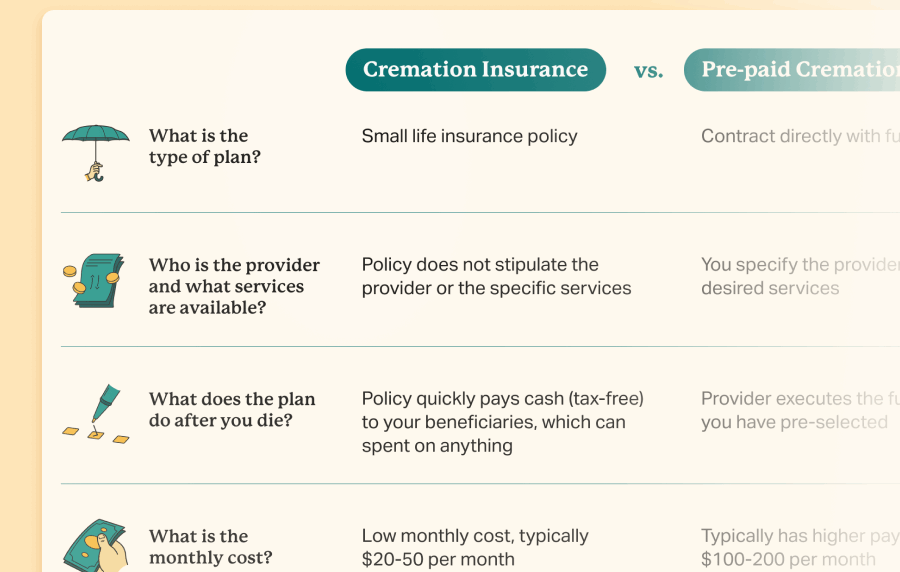
Yes, life insurance proceeds can be used for cremation expenses just like all other funeral costs. It’s not limited only to burial expenses. In fact, there are cremation insurance policies, which are a type of life insurance and meant specifically to cover cremation expenses.
Using life insurance to cover funeral costs is an excellent and recommended plan. In fact, covering funeral costs with life insurance is the number one reason people buy coverage. Just be sure to get permanent coverage and enough to cover what you think your funeral will cost. Also, ensure you select responsible beneficiaries you know will be good stewards with the money and carry out your funeral as you desire.
People in bad health will certainly have less access to certain life insurance products, but not all of them. In particular, burial insurance policies are a likely option since they are designed to accept applicants with high-risk medical conditions. Furthermore, there are guaranteed acceptance policies available as a last resort if you have truly dire health issues. With these, there are no questions of any kind, so you cannot be turned down because of your medical history. Ultimately, unless you have a mental incapacity, you can get life insurance.
Every life insurance company will require a death certificate to process a death claim. Most of them will accept a copy, but occasionally some insurers will request the original.
Every insurer is different, but it’s certainly true that some companies will require the original paper policy or a copy to file the claim. At the same time, many insurers will not. To file the claim, just call the insurer and provide the insured’s name. If you have the policy number, that will be helpful, but the insurer won’t need it (the name alone is sufficient).
There are a few ways to pay for a funeral without life insurance. First, you could consider a direct funeral, which is substantially less expensive than a traditional funeral. For example, a direct cremation often costs roughly $2,202 and a direct burial often costs roughly $5,138. You could accept donations, crowdfund, take advantage of veterans’ burial benefits, or see if your city or state offers any assistance (which many do). As a last resort, you could explore body donation, which is costless.
Preneed life insurance is a special type of policy bought directly from an insurer (or through one of their agents) that is linked to a specific funeral provider. It’s meant to cover the funeral expenses listed in your preneed contract. The major difference between this type of policy and a normal life insurance policy is that you cannot name beneficiaries. Rather, with a preneed policy, a funeral home is always the recipient of 100% of the policy’s proceeds.
An accidental death life insurance policy will only pay out to cover funeral expenses if and only if the insured dies from an accident. If so, the money that is paid out can absolutely be used to cover your final expenses. Accidental death policies only pay out a benefit for accidents. All types of natural causes of death will not result in a death benefit payout.
- Nationally licensed life insurance agent with over 16 years of experience.
- Personal annual production that puts him in the top .001% out of all life insurance agents in the nation.
Anthony Martin is a nationally licensed insurance expert with over 16 years of experience and has personally served over 10,000 clients with their life insurance needs. He frequently authors entrepreneurial and life insurance content for Forbes, Inc.com, Newsweek, Kiplinger, and Entreprenuer.com. Anthony has been consulted as an expert life insurance source for dozens of high-profile websites such as Forbes, Bankrate, Reuters, Fox Business, CNBC, Investopedia, Insurance.com, Yahoo Finance, and many more.
- Nationally licensed life insurance agent with over 20 years of experience
- Best selling Amazon author.
Jeff Root is a nationally licensed life insurance expert with over 20 years of experience. He has personally helped over 3000 clients with their life insurance needs. Jeff is a best-selling Amazon author and the managing partner of a highly successful insurance brokerage that manages over 2,500 licensed insurance agents across the USA. He has been a featured life insurance source for prestigious websites such as Forbes, Bloomberg, MarketWatch, Nerdwallet, and many more.
- Nationally licensed life insurance agent with over 15 years of experience
- Best selling Amazon author of five insurance sales books.
David Duford is a nationally licensed insurance expert with over 15 years of experience. He has personally helped more than 1,500 clients buy life insurance. David has been featured as an expert source for highly authoritative publications such as A.M. Best and Insurancenewsnet. He also runs one of the largest YouTube channels to help aspiring insurance agents serve their clients better.
- Nationally licensed life insurance agent with over 20 years of experience
- Best selling Amazon author.
Jeff Root is a nationally licensed life insurance expert with over 20 years of experience. He has personally helped over 3000 clients with their life insurance needs. Jeff is a best-selling Amazon author and the managing partner of a highly successful insurance brokerage that manages over 2,500 licensed insurance agents across the USA. He has been a featured life insurance source for prestigious websites such as Forbes, Bloomberg, MarketWatch, Nerdwallet, and many more.
- Nationally licensed life insurance agent with over 15 years of experience
- Best selling Amazon author of five insurance sales books.
David Duford is a nationally licensed insurance expert with over 15 years of experience. He has personally helped more than 1,500 clients buy life insurance. David has been featured as an expert source for highly authoritative publications such as A.M. Best and Insurancenewsnet. He also runs one of the largest YouTube channels to help aspiring insurance agents serve their clients better.
Choice Mutual often cites third-party websites to provide context and verification for specific claims made in our work. We only link to authoritative websites that provide accurate information. You can learn more about our editorial standards, which guide our mission of delivering factual and impartial content.
-
Surveys consistently show. https://www.limra.com/en/newsroom/industry-trends/2026/limra-understanding-the-elusive-life-insurance-consumer/
-
living trust. https://www.consumerfinance.gov/ask-cfpb/what-is-a-revocable-living-trust-en-1775/
-
an assignment. https://www.opm.gov/frequently-asked-questions/insure-faq/life/what-is-an-assignment/
-
incontestability period. https://www.investopedia.com/terms/i/incontestability-clause.asp
-
Life Insurance Policy Locator Service. https://eapps.naic.org/life-policy-locator/#/welcome