
Since 2020, our team has polled Americans about various aspects of funerals and other end-of-life preferences. While these conversations are always difficult, they are necessary, especially as we grow older.
In this year’s study, we explored death positivity and how comfortable people are discussing their own preferences and the wishes of loved ones. In addition to exploring this new topic, we analyzed this year’s data alongside data collected over the years to capture evolving trends across the country.
Analyzing Death Positivity In 2026
Our 2026 survey uncovers new trends in how Americans feel when discussing death, both their own and the death of loved ones.
From conversations about funeral preferences to consuming content about death, the data reveals that many people are becoming more comfortable with the topic. In fact, when asked to reflect on past feelings, we found that 50% of Americans feel more comfortable having these conversations than they did before.
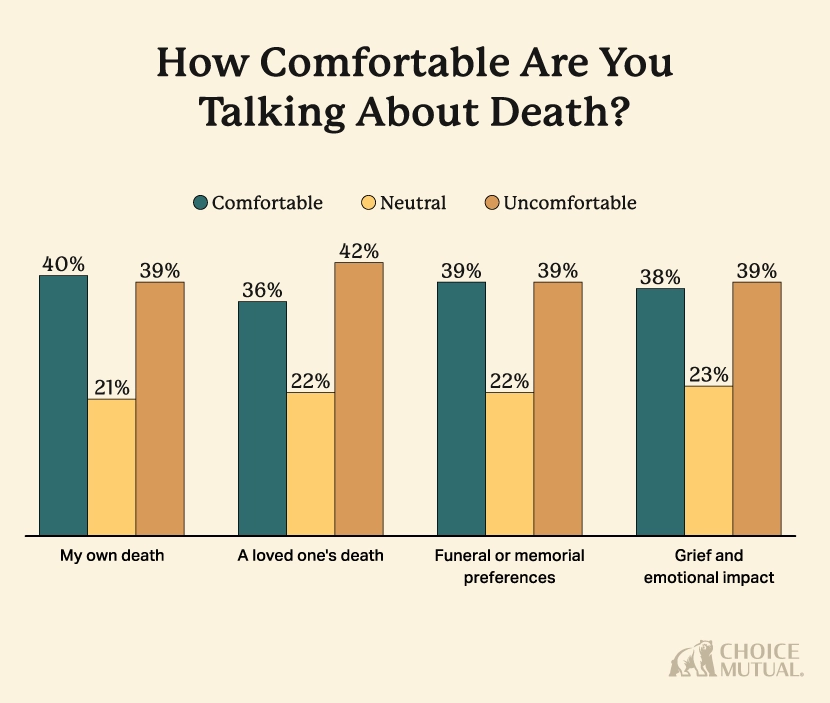
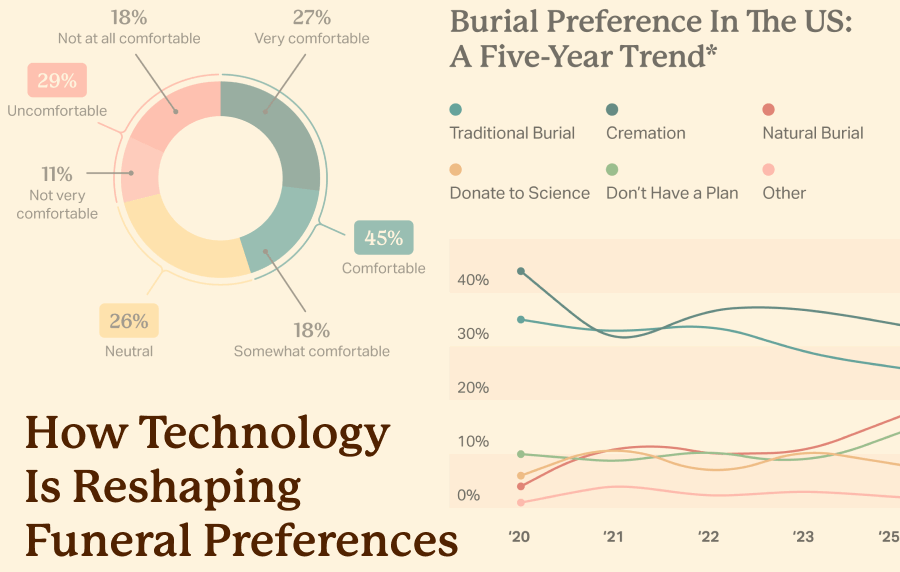
Overall, 2 in 5 Americans say they feel comfortable discussing their own death. While 39% say they feel uncomfortable with the conversation, 1 in 5 feel neutral. Understandably, we learned that older generations are more comfortable discussing their own death, with Gen Xers being the most comfortable (43%).
From discussing a loved one’s death to grief and emotional impacts of loss, we found that Americans are nearly split, with about 40% feeling comfortable, another 40% feeling uncomfortable, and the remaining 20% feeling neutral regarding the topic.
Even still, nearly 3 in 5 Americans (57%) think people are becoming more comfortable talking about death and end-of-life preferences.
To gain more insight into death positivity, we asked respondents about various conversations and events they have taken part in over recent years. Through this, we discovered that 1 in 3 Americans have had a serious conversation with someone about their own funeral preferences.
While not everyone has plans for how they want to be remembered, many do. Though the hope is that those preferences will not be needed for some time, it’s better to share them so that your wishes can be honored when the time comes.
Another common area of discussion around death is organ donation. We discovered that in recent years, 1 in 3 people have discussed their wishes with someone, and another 15% had a conversation with a loved one about their preferences.
Discussing death, whether your own or someone else’s, can be difficult. Perhaps that is why 27% of people say they have recently consumed content about death positivity.
From promoting open conversations to reducing fear around mortality, death positivity content can be incredibly helpful for anyone struggling to accept death.
Burial Preferences Over The Years
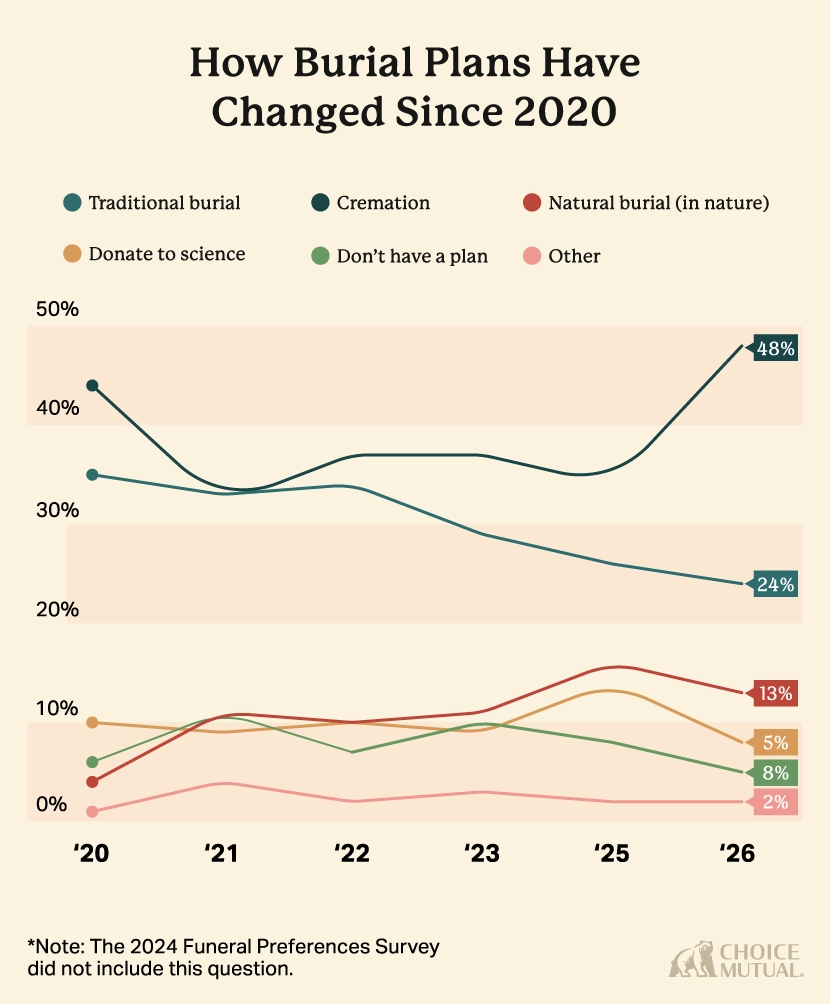
Each year in our Funeral Preferences Survey, we have asked Americans about their burial plans. Except in 2021, cremation has been the most preferred type of burial. This year, 48% of Americans shared they would like to be cremated, the most of any year we have conducted this study.
Because of the popularity of cremation, we asked respondents what they would like done with their ashes. Leading the way, with nearly 2 in 5 people reporting it, is having their ashes scattered in a meaningful place. Nearly 1 in 5 Americans would want their ashes returned to the ground, either turning them into a tree or planting them as a memorial.
Not all have grand plans for their ashes; however, 16% report they would simply like them kept in an urn by their family.
Coming in second place is a traditional burial (24%), which includes embalming the body and laying it to rest in a casket with a headstone. This is followed by a natural burial in third place (13%), which leaves the body as is, without embalming, and a biodegradable burial in nature.
For many people, being buried means taking prized possessions with you. As part of our study, we asked respondents what items, if any, they would want to be buried with. Overall, jewelry and photos were the most common items.
However, we also discovered a great deal of variety in what people wanted to take to the grave.
Among the items was a bottle of Buffalo Trace bourbon whiskey. Another person wanted to be buried with a stone from their favorite beach, while another wanted their Lord of the Rings sword.
Americans alternative burial preferences
While traditional burial options are often what people initially think of when deciding how they want to be memorialized, they can be more expensive and have lasting environmental impacts.
To better understand these impacts on Americans’ decisions, we asked respondents about various factors and whether they would choose an alternative burial instead. Leading the way as the most common factor impacting people’s decision is the cost associated with a burial, as 83% say a lower overall cost would influence them.
For 73% of Americans, the environmental benefits of an alternative burial would cause them to select it over a traditional burial. Similarly, 68% of people would select an alternative burial if it offered a more meaningful or symbolic memorial.
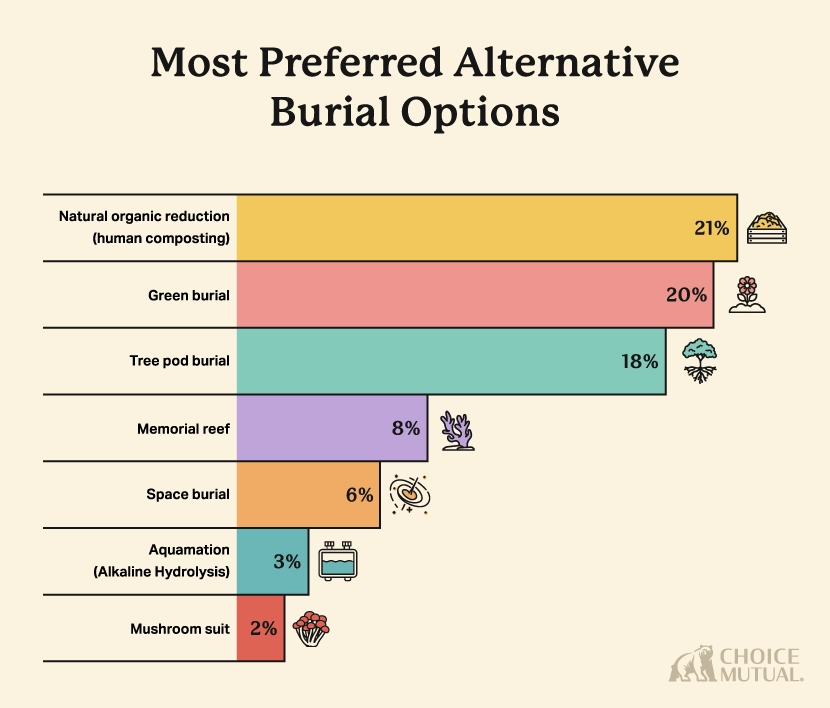
When asked about specific types of alternative burials, we found that natural organic reduction, or human composting, was the most common. 21% of people said they would choose it if a traditional burial were not available. This is followed by a green burial (20%) and a tree pod burial (18%) as the second and third-place alternatives, respectively.
Overall, we found that Gen Zers (8%) are the most likely generation to desire a space burial. Similarly, men (9%) are more likely than women (3%) to be interested in space burial. When it comes to tree pod burials, millennials (24%) showed the most interest. In comparison, Gen Xers (22%) and Baby Boomers (20%) were most likely to consider a green burial.
Covering the cost of burials
In a recent report, we shared that the average cost of a funeral in 2026 is nearly $10,000, with cremation averaging nearly $7,000. In some cases, death is sudden and unexpected, and covering the costs associated with a burial or memorial can be difficult without planning.
That’s why it is important to have difficult conversations with family to understand how these types of costs will be covered when the time comes.
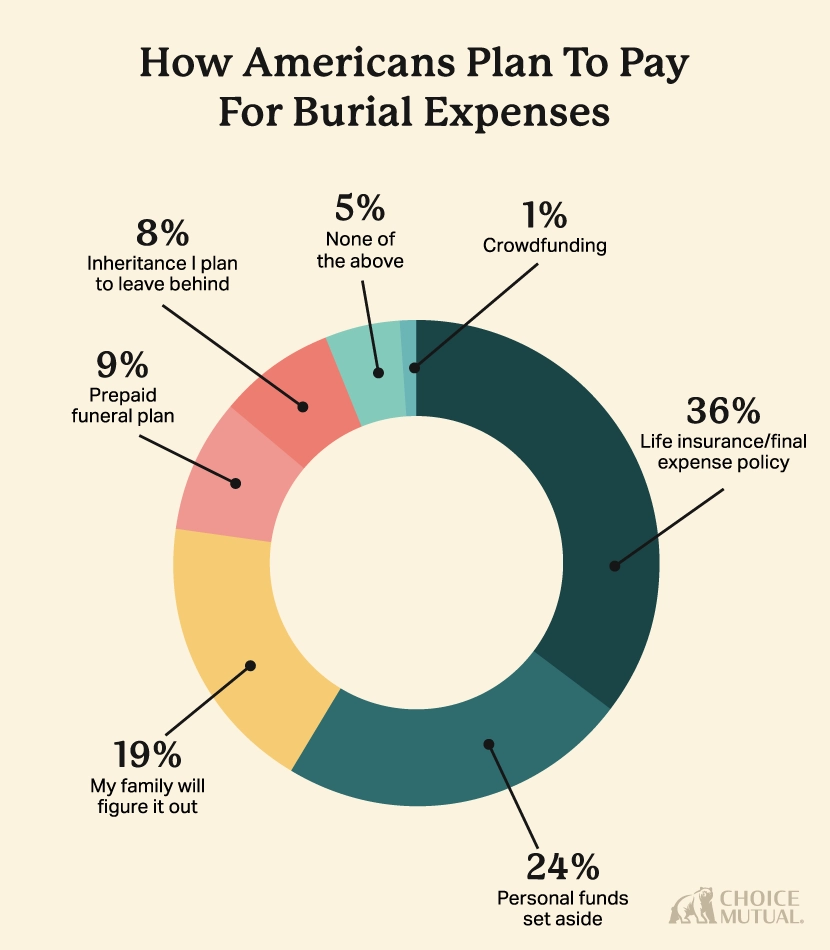
Through our research, we discovered that 36% of Americans have a life insurance or final expense policy in place to cover their burial and funeral costs. Nearly 1 in 4 Americans plan to use personal funds set aside to cover their arrangements.
While some people have more concrete plans in place, many are simply planning around expectations. This is shown by the nearly 1 in 5 Americans who say their family will figure it out. Unfortunately, many people lack the funds to cover these costs, leading to financial hardship and even debt.
Americans’ Opinions On Grief Technology
In last year’s Funeral Preferences Survey, we focused our report on grief technology and Americans’ opinions on it. From digital memorials to livestreamed funerals, we learned that many people were open to using technology to remember loved ones. When it came to certain tech like AI messages, however, many Americans were not fond of the idea.
This year, we returned to the topic once again to learn how opinions had changed, if at all. While 1 in 5 people consider grief tech tools comforting, 79% think they are creepy.
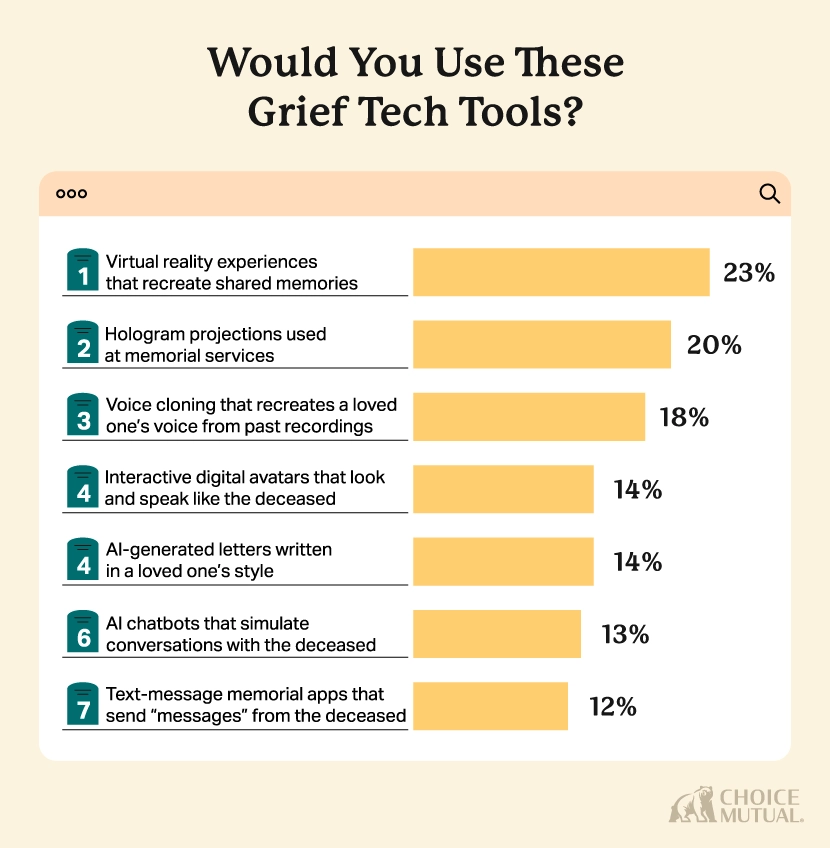
When asked about specific tools, we found that most Americans would not consider using them. On the other hand, some people were interested in certain tools. Leading the way as the most well-received grief tech tool is a virtual reality experience that recreates shared memories with loved ones, which nearly 1 in 4 people said they would consider.
Up next, with 20% of people showing interest, are hologram projections designed for a memorial service. This is followed by voice cloning that recreates a loved one’s voice from past recordings (18%).
In 2025, we found that 45% of Americans were comfortable with the idea of livestreamed funerals. However, only 40% said they would be comfortable this year. With that being said, last year, 39% of respondents said they would like their loved ones to create a digital memorial, but in 2026, that number jumped to 58%.
Perhaps this is due in part to the fact that 72% of Americans say it’s important that future generations can easily access and learn about the lives and memories of those who’ve passed away. By creating a digital memorial with photos, videos, and messages to be opened after you are gone, you provide an archive of sorts to be shared for years to come.
Methodology
In this study, we set out to learn more about Americans’ funeral preferences in 2026. To do this, we surveyed 1,516 people across the U.S. and asked a variety of questions about their burial preferences, plans to pay for their funeral/burial costs, what items they’d want to be buried with, and more.
- Nationally licensed life insurance agent with over 16 years of experience.
- Personal annual production that puts him in the top .001% out of all life insurance agents in the nation.
Anthony Martin is a nationally licensed insurance expert with over 16 years of experience and has personally served over 10,000 clients with their life insurance needs. He frequently authors entrepreneurial and life insurance content for Forbes, Inc.com, Newsweek, Kiplinger, and Entreprenuer.com. Anthony has been consulted as an expert life insurance source for dozens of high-profile websites such as Forbes, Bankrate, Reuters, Fox Business, CNBC, Investopedia, Insurance.com, Yahoo Finance, and many more.
- Nationally licensed life insurance agent with over 20 years of experience
- Best selling Amazon author.
Jeff Root is a nationally licensed life insurance expert with over 20 years of experience. He has personally helped over 3000 clients with their life insurance needs. Jeff is a best-selling Amazon author and the managing partner of a highly successful insurance brokerage that manages over 2,500 licensed insurance agents across the USA. He has been a featured life insurance source for prestigious websites such as Forbes, Bloomberg, MarketWatch, Nerdwallet, and many more.
- Nationally licensed life insurance agent with over 15 years of experience
- Best selling Amazon author of five insurance sales books.
David Duford is a nationally licensed insurance expert with over 15 years of experience. He has personally helped more than 15,000 clients buy life insurance. David has been featured as an expert source for highly authoritative publications such as A.M. Best and Insurancenewsnet. He also runs one of the largest Youtube channels to help aspiring insurance agents serve their clients better.
- Nationally licensed life insurance agent with over 20 years of experience
- Best selling Amazon author.
Jeff Root is a nationally licensed life insurance expert with over 20 years of experience. He has personally helped over 3000 clients with their life insurance needs. Jeff is a best-selling Amazon author and the managing partner of a highly successful insurance brokerage that manages over 2,500 licensed insurance agents across the USA. He has been a featured life insurance source for prestigious websites such as Forbes, Bloomberg, MarketWatch, Nerdwallet, and many more.
- Nationally licensed life insurance agent with over 15 years of experience
- Best selling Amazon author of five insurance sales books.
David Duford is a nationally licensed insurance expert with over 15 years of experience. He has personally helped more than 15,000 clients buy life insurance. David has been featured as an expert source for highly authoritative publications such as A.M. Best and Insurancenewsnet. He also runs one of the largest Youtube channels to help aspiring insurance agents serve their clients better.