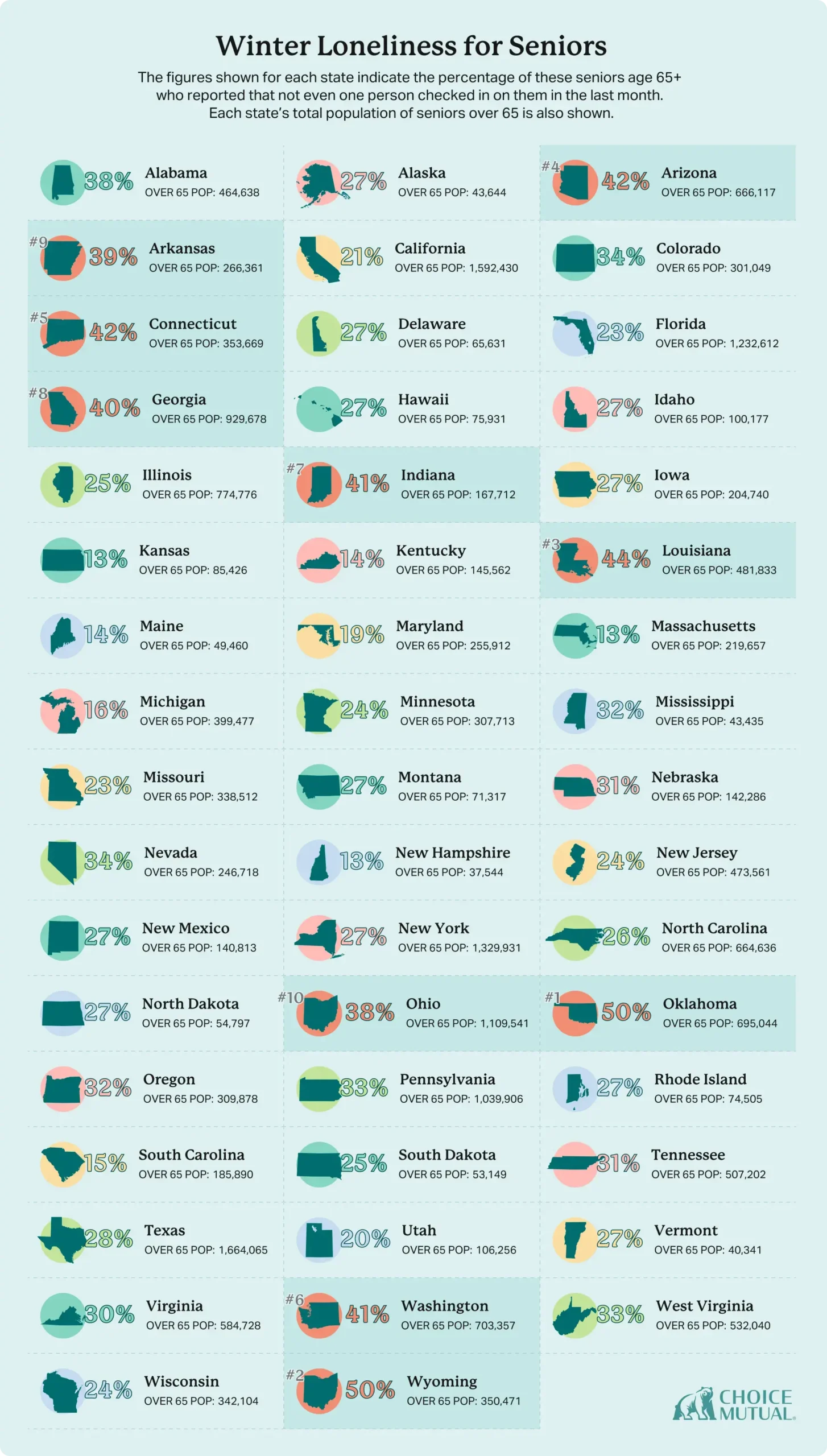
Full Survey Results
Key Findings
Some regions appear to offer a stronger “winter buffer.”
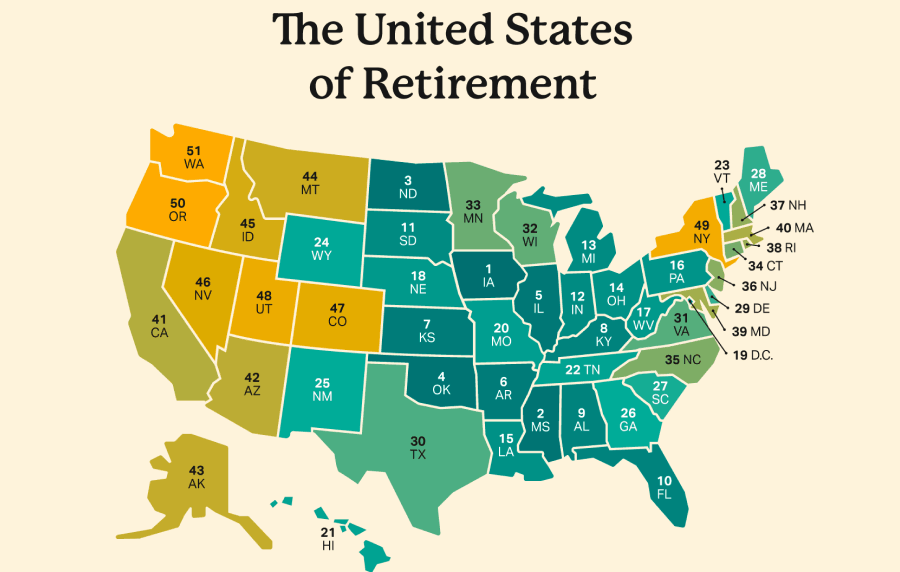
The New England-to-Mid-Atlantic corridor has a cluster of low-loneliness states: New Hampshire (13%), Massachusetts (13%), and Maryland (19%) sit well below the national average of 27%.
Whether that comes from denser towns, closer-knit communities, or more established senior-support networks is open to interpretation – but the trend is remarkably consistent.
Winter is absolutely the emotional low point.
The season doesn’t just nudge loneliness – it amplifies it. Nearly three-quarters of older adults living alone say winter is when their loneliness feels at its worst.
And it isn’t only people living solo: 65% of those with a partner say they still sometimes feel lonely in winter, which suggests the issue isn’t simply about who’s in the house, but how connected people feel to the world around them.
The “invisibility effect” is real and widespread.
One of the starkest figures is that 68% say they feel forgotten or invisible during the winter months.
For a lot of people, loneliness isn’t silence – it’s feeling like they have slipped off the radar entirely. That emotional weight likely feeds into the next set of numbers.
Support networks are often scarce.
The survey revealed that almost a third of older people confided that they have no one to reach out to when life becomes difficult.
When we pair that with the 58% who admit to already worrying that isolation is harming their health, the picture becomes more pronounced: this isn’t simply low-level loneliness, but something people see as actively damaging.
Many avoid asking for help.
Only 28% say they are very likely to reach out when loneliness spikes. A combined 40% say they are unlikely or very unlikely to ask for help at all.
You end up with a loop where the loneliest are often the least vocal, which may explain why so many go unnoticed.
Loneliness isn’t just emotional – it’s physical.
Over 60% say loneliness has affected their health this winter, either significantly (24%) or somewhat (38%).
Given that chronic loneliness has been linked to mortality risks comparable to heavy smoking, this becomes more than a well-being issue; it’s a genuine public-health red flag.
And the simplest fix might be the most effective.
A striking 64% say their well-being would improve if someone simply reached out more often. Not therapy, not programs – just more contact.
Final Thoughts
Winter loneliness doesn’t announce itself loudly – it creeps in through routine silence and the slow fading of human contact.
What this survey highlights is a national picture made up of millions of small, invisible stories: the neighbor who didn’t get a knock on the door, the parent whose phone didn’t ring, the person who went 31 days without anyone acknowledging they exist.
But it also shows something else: the solution isn’t complicated.
A small gesture is often enough to pull someone back into the world. And our data shows that even brief contact can make a difference instantly.
Methodology
This study is based on a survey of 3,025 U.S. respondents, conducted in December, exploring how people would choose to spend their final New Year’s Eve. The sample was designed to reflect a broad cross-section of the population, with balance across age, gender, and geographic region to ensure the findings represent nationwide sentiment.
Stratified sampling was used to capture demographic variation, followed by post-stratification weighting to align results with national population benchmarks. Together, the data offer a snapshot of how Americans imagine marking a final New Year’s Eve, revealing the experiences and settings they value most when reflecting on closure, meaning, and celebration.
- Nationally licensed life insurance agent with over 16 years of experience.
- Personal annual production that puts him in the top .001% out of all life insurance agents in the nation.
Anthony Martin is a nationally licensed insurance expert with over 16 years of experience and has personally served over 10,000 clients with their life insurance needs. He frequently authors entrepreneurial and life insurance content for Forbes, Inc.com, Newsweek, Kiplinger, and Entreprenuer.com. Anthony has been consulted as an expert life insurance source for dozens of high-profile websites such as Forbes, Bankrate, Reuters, Fox Business, CNBC, Investopedia, Insurance.com, Yahoo Finance, and many more.