

How Does Participating Whole Life Insurance Work?
Participating whole life insurance policies can pay dividends if the insurer posts sufficient profits. Essentially, the insurance company will assess whether it needs the excess funds. If they don’t, they will declare a dividend payment to all eligible policyholders.
Dividends are not guaranteed because they depend entirely on insurers’ financial performance. It’s worth noting that mutual insurers have not paid a dividend twice in history, once during the Great Depression and once during the 2008 housing crisis. All in all, it’s a virtual certainty that if you have a participating whole life policy, the insurer will be paying dividends.
If dividends are declared, they are often paid annually, quarterly, or biannually.
Being a form of whole life insurance, the coverage lasts a lifetime, builds cash value, and has a fixed cost. Whenever you die, the insurer will pay the death benefit as cash, which they can spend however they like.
How You Can Use The Dividends
There are a variety of ways the policyholder can utilize dividend payments, such as:
- Additional coverage: Often referred to as “paid up additions (PUAs)”, the dividend payment is used to buy a fully paid-up death benefit that increases your total coverage. The additional coverage is permanent and does not increase your premiums, nor is any further payment required.
- Cash: The insurer can send you a cash payment (via check), which you can spend however you’d like.
- Pay premiums: You can opt to use the money to offset the policy’s premiums.
- Increase cash value: If you leave the money with the insurer, it will increase the cash value, thus enhancing the interest that accrues over time.
- Pay down policy loans: If you have an outstanding policy loan, you can allocate the dividend payment to pay it down.
How Much Does Participating Whole Life Insurance Cost?
The cost of participating in whole life insurance is based on many factors, such as your age, gender, state of residence, tobacco use, health history, and the amount of coverage you choose.
Sample Case Studies Showing Cash Value Growth And Dividends
Below are two sample illustrations for a participating whole life policy that show how the cash value grows over time, the annual dividends, and the projected death benefit. Remember that every policy or illustration will have a cash value chart that clearly outlines these figures.
$100,000 particpating whole life insurance policy sample illustration
Premiums are calculated at a non-tobacco preferred rating, rounded to the nearest dollar, and are valid as of 03/09/2026.
$500,000 particpating whole life insurance policy sample illustration
Premiums are calculated at a non-tobacco preferred rating, rounded to the nearest dollar, and are valid as of 03/09/2026.
Participating Vs Non-Participating Whole Life Insurance
| Policy Features | Participating Whole Life | Non-Participating Whole Life |
|---|---|---|
| Possibility of dividend payments | Yes | No |
| Insurer's profits | Shared with the policyowners | Kept by the insurer |
| Affordability | Higher cost | Lower cost |
| Fixed premiums | Yes | Yes |
| Coverage length | Forever | Forever |
| Builds cash value | Yes | Yes |
| Can borrow from the cash value at any time | Yes | Yes |
| Death benefit guaranteed never to decrease | Yes | Yes |
Pros And Cons Of Participating Whole Life Insurance
- Flexibility: You’re able to use the dividends in all sorts of ways, including taking them as cash or to increase your death benefit.
- Lifelong coverage: Whole life insurance protects you forever.
- Potential to benefit when the insurer does well: It’s nice knowing that when the insurer posts unnecessary profits, they share the benefits with the policyholders.
- Fixed rate: Premiums for whole life policies can never increase.
- Higher cost: Premiums for participating life insurance policies are higher than those for non-participating ones. However, it’s often not much higher.
- Not guaranteed: Dividend payments are not guaranteed. It all depends on whether the insurer reports a profit and doesn’t need that money for operations. Only then will a dividend payment be declared. This could be problematic if you begin relying on the dividend payments to pay your bills.
- Limited availability: Participating whole life insurance is not always available. Nearly every insurer offers whole life insurance, but often doesn’t offer a participating option. For example, Mutual of Omaha is one of the largest life insurance companies in the USA. While they offer whole life insurance, they do not have a participating policy.
- True investment products usually offer greater returns: If you’re interested in investing your money for growth, traditional investment products such as index or mutual funds typically generate greater returns than the dividend payments you would get with a participating life insurance policy.
Alternative Life Insurance Options
If you need life insurance, it’s wise to evaluate all your options, not just participating policies. Above all else, be sure to consider your goals and then choose the life insurance type based on which one will give you the best chance at achieving said goals. Below are some other policy options to consider.
Non-participating whole life insurance
Also known as traditional or standard whole life insurance, these policies cannot pay dividends. The advantage is that they are generally lower in cost and easier to qualify for. You still retain all the benefits of a whole life policy, such as lifetime coverage, cash value growth, and a fixed premium.
Limited-pay whole life
Limited-pay whole life policies stipulate that you only need to make premium payments for a specified period, such as 10 or 20 years. After you’ve made all the required payments, the policy becomes paid up and requires no further payments. While the payments stop, the coverage remains in force for the rest of your life.
Universal life insurance
There are flexible permanent policies that build cash value and offer a level premium. The policyholder can choose to increase or decrease their payment at any time (which cannot be done with whole life or term life). Overall, universal life policies are less expensive than all types of whole life insurance.
Term life insurance
Term life insurance is temporary coverage that lasts only for a defined period. Terms policies usually only last for 10–30 years. Once the policy reaches its endpoint, coverage terminates. Term life insurance is unquestionably the most affordable type of life insurance, which is its main advantage.
Final expense insurance
Final expense insurance is a type of small whole-life policy designed to cover your end-of-life expenses. If you only need coverage for your funeral costs, final expense policies are inexpensive since the coverage amounts are fairly small (less than $50,000).
Cremation insurance
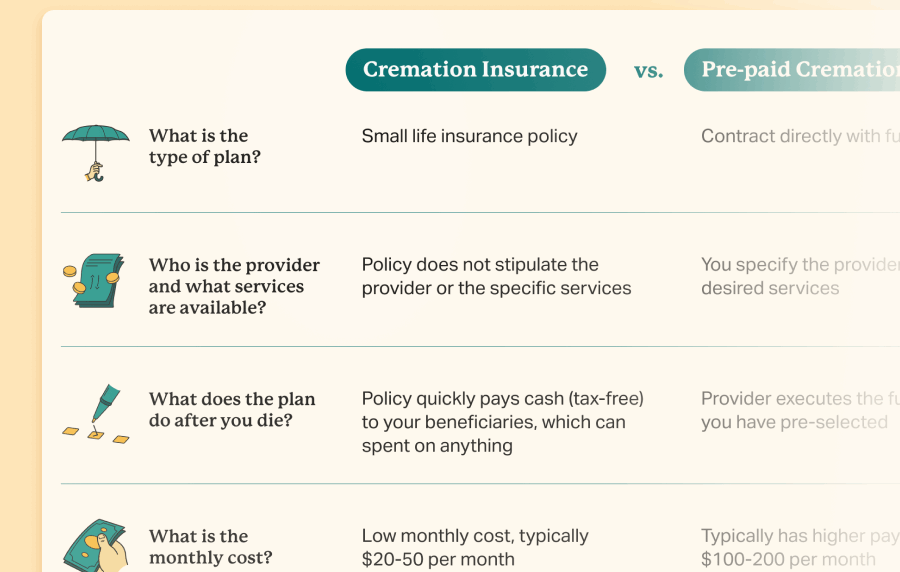
Cremation policies are very small whole life policies meant to cover your cremation costs. Premiums are very low since the coverage is usually less than $10,000.
Frequently Asked Questions
In most cases, there are no taxes due when you opt for a cash distribution of the dividend, unless the value exceeds the amount you’ve paid into the policy (which is nearly impossible).
Participating whole life insurance, while it costs more, is generally a good investment. For a modest increase in cost, you get the upside of sharing in the insurance companies’ profits. Furthermore, there is considerable flexibility in how dividend payments are used. These policies don’t come with small coverage options ($100,000 is often the minimum you can buy) and often have tighter underwriting restrictions. That said, if you want whole life insurance and can qualify for a participating policy, it would be wise to do so.
There are no participating term life policies, nor are there any participating universal life policies.
Borrowing from the cash value in your policy can reduce how much of a dividend payout you get. It depends on the insurer and the amount of your outstanding loan.
- Nationally licensed life insurance agent with over 16 years of experience.
- Personal annual production that puts him in the top .001% out of all life insurance agents in the nation.
Anthony Martin is a nationally licensed insurance expert with over 16 years of experience and has personally served over 10,000 clients with their life insurance needs. He frequently authors entrepreneurial and life insurance content for Forbes, Inc.com, Newsweek, Kiplinger, and Entreprenuer.com. Anthony has been consulted as an expert life insurance source for dozens of high-profile websites such as Forbes, Bankrate, Reuters, Fox Business, CNBC, Investopedia, Insurance.com, Yahoo Finance, and many more.
- Nationally licensed life insurance agent with over 20 years of experience
- Best selling Amazon author.
Jeff Root is a nationally licensed life insurance expert with over 20 years of experience. He has personally helped over 3000 clients with their life insurance needs. Jeff is a best-selling Amazon author and the managing partner of a highly successful insurance brokerage that manages over 2,500 licensed insurance agents across the USA. He has been a featured life insurance source for prestigious websites such as Forbes, Bloomberg, MarketWatch, Nerdwallet, and many more.
- Nationally licensed life insurance agent with over 15 years of experience
- Best selling Amazon author of five insurance sales books.
David Duford is a nationally licensed insurance expert with over 15 years of experience. He has personally helped more than 15,000 clients buy life insurance. David has been featured as an expert source for highly authoritative publications such as A.M. Best and Insurancenewsnet. He also runs one of the largest Youtube channels to help aspiring insurance agents serve their clients better.
- Nationally licensed life insurance agent with over 20 years of experience
- Best selling Amazon author.
Jeff Root is a nationally licensed life insurance expert with over 20 years of experience. He has personally helped over 3000 clients with their life insurance needs. Jeff is a best-selling Amazon author and the managing partner of a highly successful insurance brokerage that manages over 2,500 licensed insurance agents across the USA. He has been a featured life insurance source for prestigious websites such as Forbes, Bloomberg, MarketWatch, Nerdwallet, and many more.
- Nationally licensed life insurance agent with over 15 years of experience
- Best selling Amazon author of five insurance sales books.
David Duford is a nationally licensed insurance expert with over 15 years of experience. He has personally helped more than 15,000 clients buy life insurance. David has been featured as an expert source for highly authoritative publications such as A.M. Best and Insurancenewsnet. He also runs one of the largest Youtube channels to help aspiring insurance agents serve their clients better.